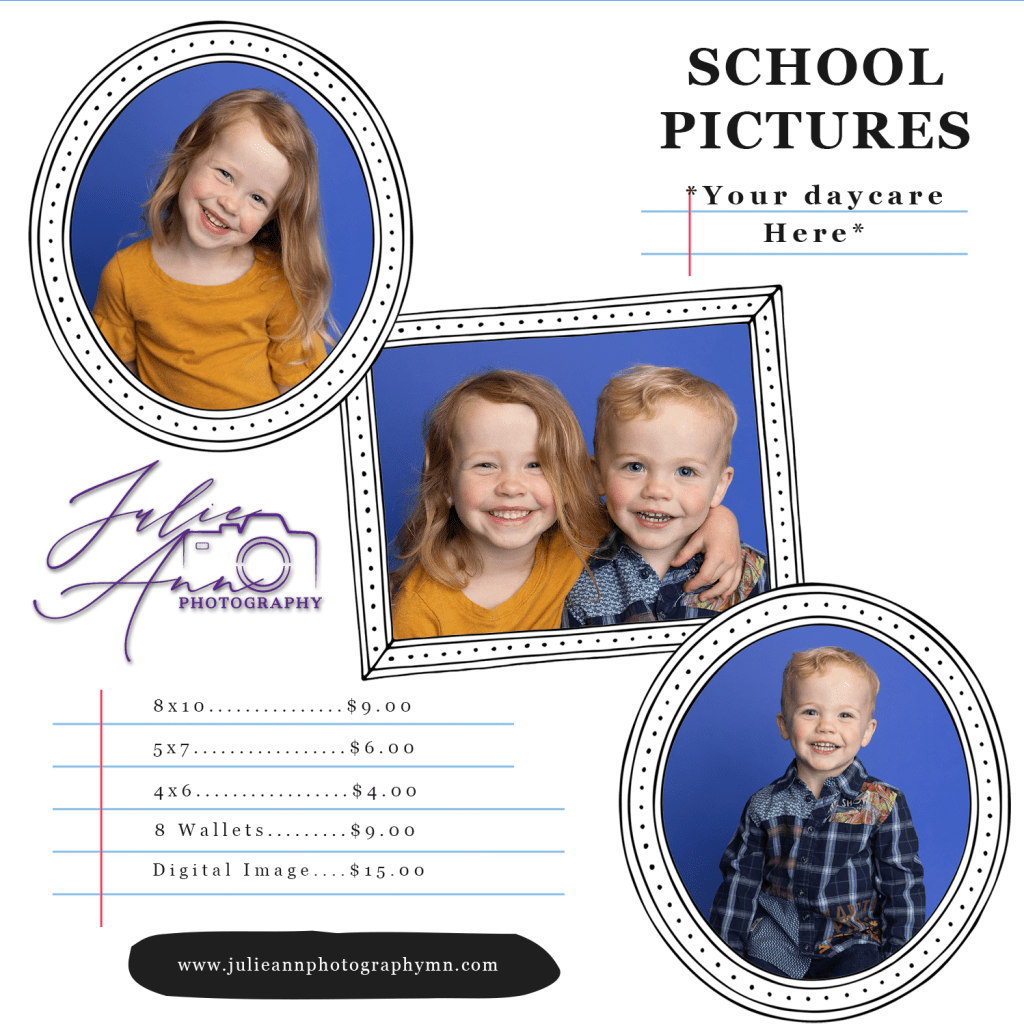
In my search to find in-home daycare providers to partner with to offer parents school photos portraits, I came to realize that many of the resources I used to find providers may not be on every parents’ radar. I used to work in daycare centers and have a Child Development Certificate from Saint Paul College as well as many additional credits in child development to become teacher qualified to work in daycare centers. I have worked with all age groups, from infants, toddlers through all preschool-age groups as well. I started as an aide in the classroom and worked my way up to lead teacher through school credits and my degree. In many of these classes we learned about licensing requirements, compliance and how to look up information to do our research on places to consider working and providing care and education to children.
I’ve put together some helpful information for parents looking for care for their children. I am by-no-means a complete expert, but my educational background has helped me become aware of specific resources and I hope that passing on this information can help parents who may have no idea where to start.
1. Begin with the DHS Licensing Information Lookup
Minnesota’s DHS Licensing Information Lookup (LIL) is the authoritative source for state‑licensed child care providers, including family child care homes. Using the tool:
- Search by provider name, city, ZIP code, or license number
- Each listing shows:
- Current license status and effective date;
- Type of service offered;
- Results of monitoring visits, marked as “in compliance” when no violations were found or listed with plain‑language summaries if issues exist.
- Monitoring records and licensing actions—including correction orders or maltreatment investigations—are retained for four years in the system.
Steps you can follow:
- Go to the Minnesota DHS Licensing lookup site: https://licensinglookup.dhs.state.mn.us/
- Enter your city or ZIP and select Family Child Care.
- Review provider entries and click through details for violations or license history.
This ensures the provider holds a valid license and that you see any recent compliance issues.
2. Use Parent Aware’s Tools and Guides
Parent Aware is Minnesota’s quality rating and referral system (QRIS) for licensed child care and early learning programs.
What you get:
- Interactive search tool: search by location, hours, ages served, and see star‑ratings (1–4) based on research‑based practices
- Finding Child Care: A Guide for Families: step‑by‑step questions to ask, what to observe on provider visits, checklists, and additional support resources
- “Understanding Licensing Records” section: helps interpret LIL data—what monitoring results mean, definitions of license statuses and common violation types
Why use Parent Aware:
- It connects licensing data with quality metrics (star‑ratings).
- Offers guidance and direct support via phone/chat or free consultation at 888‑291‑9811
- Supports multiple languages: English, Spanish, Somali, Hmoob.
3. Explore ParentAware.org for Resources
At ParentAware.org, you’ll find:
- The Finding Child Care Guide, available in English, Spanish, Somali, and Hmong – full of practical checklists, interview questions, and evaluation tips for family caregivers.
- Advice on health and safety, background check requirements, licensing expectations, and what to know about exempt (unlicensed) care settings like neighbors or in‑home providers in the child’s home Parent Aware.
- Explanation of how county licensors manage family child care oversight—even though licensing happens at state level, inspections and enforcement are conducted locally.
🧩 Sample Workflow for Parents
| Step | Action |
|---|---|
| 1. Brainstorm | List in‑home providers you’re interested in (or search by neighborhood). |
| 2. DHS Lookup | Use LIL to verify license status and check for violations. |
| 3. Parent Aware search | Compare ratings, program features, and openings. |
| 4. Read the Guide | Download “Finding Child Care” to craft questions and organize your visits. |
| 5. Interview/Visit | Ask about staff training, caregiver‑to‑child ratios, background checks, meal and nap policies, emergency plans, and discipline approaches. |
| 6. Follow up | Ask for references or speak with other parents. Confirm current openings, fees, and policies. |
⚠ Points to Keep in Mind
- License-exempt care (e.g., family/friend care, in‑home care in the child’s own home) doesn’t appear in DHS search results and isn’t regulated. If considering these, explicitly ask the provider how they ensure safety and health practices.
- Family child care licensing moved from DHS to the new Department of Children, Youth, and Families (DCYF) on June 18, 2025. Existing licenses remain valid, and the requirements remain unchanged—only statutes were renumbered (now Minnesota Statutes, chapter 142B, and Rule 9502) mn.gov // Minnesota’s State Portal.
- Licenses now renew automatically each calendar year when fees are paid by December—no more expiring mid‑year as in the past mn.gov // Minnesota’s State Portal.
✅ Final Thoughts
By combining:
- DHS Licensing Lookup (for legal status and compliance),
- Parent Aware search and quality ratings,
- And the Finding Child Care Guide for structure and smart interview tips,
you’ll be well-equipped to do your research to find a safe, high-quality, right-fit family child care provider in Minnesota.
 Julie Ann Photography • MINNEAPOLIS PHOTOGRAPHER